
By the Jomsom Staffing Editorial Team. Updated November 2026. Jomsom Staffing, a workforce solutions provider, publishes this post. It mentions our own services. It is general information, not legal, tax, or financial advice. Fees vary by firm, role, and market.
Direct hire placement fees are what you pay a recruiter. The recruiter finds you a permanent hire. A common planning range is 15% to 25%. In SIA’s survey, 20% was most common. The percentage applies to first-year pay. Senior and hard-to-fill roles often cost more.
That is the short answer. The full picture has more parts. What counts as “first-year pay”? When is the bill due? What if the hire quits fast? This guide covers each question. It also shows real math. You can use it to plan your budget.
Key Takeaways
- Most direct hire placement fees are one-time charges.
- A common planning range is 15% to 25%.
- SIA found 20% was most common.
- Fees are based on first-year pay.
- Contingency firms earn a fee only if you hire.
- Retained searches may need upfront payments.
- Surveyed recruiters most often offered 90-day guarantees.
- You can often negotiate the rate and terms.
- Read what “salary” means in the contract.
What Are Direct Hire Placement Fees?
A direct hire is a permanent hire. The worker joins your payroll on day one. They are not on the recruiter’s payroll. The recruiter only finds, screens, and presents them. You then make the offer and hire.
Staffing Industry Analysts defines it this way, too. In SIA’s definition, the firm earns its fee only at hire. The fee is normally a share of first-year salary. Outside North America, people call it “permanent placement.”
Under contingency, a direct hire placement fee is a success fee. You pay for a result, not effort. Retained and engaged searches work differently. They may involve upfront or staged payments. Many employers like the contingency model. You keep control of the final choice. You also keep the worker on your own payroll.
How Much Are Direct Hire Placement Fees?
Most direct hire placement fees use a percentage. The base is the hire’s first-year pay. Here is what industry research shows.
SIA research found 20% was the most common fee. About 42% of staffing firms charged that rate. SIA also found clear ranges by firm type. The data comes from its 2021 survey. That survey covered North America only. Treat these as established benchmarks. They are not a 2027 forecast.
| Type of firm | Typical fee range (SIA) |
|---|---|
| Commercial staffing firms | 15% to 20% |
| Professional staffing firms | 18% to 22% |
| Direct-hire firms | 20% to 25% |
Source: SIA North America Staffing Company Survey 2021, reported by SIA. Ranges are midranges, not limits.
Other sources show similar staffing agency fees for direct hire. An Upwork guide puts direct hire fees near 18% to 25%. Some firms charge more for rare skills. Senior and executive roles can cost more. Retained executive search may cost more than contingency. Clients often pay it in installments.
The takeaway is simple. Use 15% to 25% as a planning range. Start with about 20%. Then adjust for the role. Easy roles may cost less. Rare or senior roles may cost more.
Direct Hire Placement Fees: Cost Examples
Percentages are easy to read. Dollars are easier to plan with. The table below shows sample direct hire placement fees. Each one uses first-year base pay.
| Role example | First-year pay | Fee at 15% | Fee at 20% | Fee at 25% |
|---|---|---|---|---|
| Office administrator | $45,000 | $6,750 | $9,000 | $11,250 |
| Warehouse supervisor | $60,000 | $9,000 | $12,000 | $15,000 |
| Staff accountant | $70,000 | $10,500 | $14,000 | $17,500 |
| Mechanical engineer | $95,000 | $14,250 | $19,000 | $23,750 |
| IT manager | $130,000 | $19,500 | $26,000 | $32,500 |
These are sample figures for planning only. Real pay and fees vary by market and firm.
The math is the same every time. Multiply first-year pay by the fee rate. A $60,000 hire at 20% costs $12,000. A $95,000 hire at 25% costs $23,750. Run this math before you sign.
What Counts as “First-Year Pay”?
This is where many surprises start. Every recruiter placement fee has a defined base. Some use base salary only. Others use total first-year cash pay. That can include bonuses and sign-on money.
Recruiterflow notes this point clearly. A good contract defines pay with care. It may list base pay, bonuses, or allowances. Each choice changes the final bill.
Here is a quick example. Your hire earns a $80,000 base salary. They also get a $10,000 sign-on bonus. The fee rate is 20%. On base pay only, you pay $16,000. On total cash, you pay $18,000. That is a $2,000 gap.
Ask these questions about direct hire placement fees first:
- Is the fee on base pay only? Get it in writing.
- Are bonuses included? Ask about sign-on and annual bonuses.
- Is commission included? Sales roles often carry commission.
- Is there a fee floor? Some firms set one.
- What if pay changes later? Ask if the fee changes too.
The Main Fee Models for Direct Hire
Not all direct hire placement fees work the same way. There are five common models. Each one shifts risk in a different way.
Contingency Search
This is the most common model for direct hire placement fees. You pay only if you hire. The firm takes on the risk. If no hire happens, you owe nothing. Contingency fees often fall between 15% and 25%.
This model fits most staff-level roles. It works well for office, warehouse, and skilled trades. It also works for many professional roles. Many employers use more than one contingency firm.
Retained Search
Retained search is for senior roles. Its direct hire placement fees come in parts. You pay some up front. You pay more at set steps. The last payment comes at hire. The firm works only for you.
Firms often split payments into installments. Some firms split the fee in thirds. Retained fees may be higher than contingency. They fit executives and rare leaders.
Engaged or Container Search
This model sits in the middle. You pay a small deposit up front. The rest is due at hire. The deposit shows you are serious. In return, the firm gives your search priority.
Flat Fee
Some firms set flat direct hire placement fees. The dollar amount does not change with salary. Flat fees are easy to budget. They are more common for high-volume hiring. They are less common for senior roles.
Pay-Over-Time Options
A few firms let you pay direct hire placement fees monthly. You pay after each month the hire works. If the hire leaves, billing stops. The total rate is often similar. Only the timing and risk change.
What Drives Direct Hire Placement Fees Up or Down?
Direct hire placement fees are not random. Several factors shape the rate. Know these before you negotiate.
Role level. Senior roles take more time. They need deeper screening. The fee often rises with seniority.
Skill scarcity. Some skills are hard to find. Think engineers, nurses, and IT security. Fewer candidates means more search work. That can push the rate higher.
Location. Some local markets are tight. Recruiters may need to search wider. That adds time and cost.
Speed. Need someone in two weeks? Rush searches take more effort. Some firms charge more for urgent roles.
Exclusivity. Will one firm handle the role alone? Exclusive searches often earn a lower rate. The firm knows its work will pay off.
Volume. Are you hiring many people? Ask about a volume discount. Many firms reward repeat business.
Job market. Hiring conditions matter, too. The BLS JOLTS report showed 7.5 million job openings in September 2026. The openings rate was 4.5%. Many open jobs means more competition for talent.
Direct Hire Fees vs. Your Own Cost Per Hire
Are direct hire placement fees worth it? Compare them to hiring on your own. Internal hiring is not free. You pay for ads, tools, and staff time. You also pay while the seat stays empty.
SHRM’s 2025 benchmarking offers useful figures. SHRM reported an average nonexecutive cost per hire of $5,475. The executive average was $35,879. Those numbers include recruitment agency fees for some firms. These benchmarks measure total recruiting cost. They are not agency placement fees alone. Use them as context, not a one-to-one match.
SHRM’s 2026 data brief shows a rising trend. The median executive cost per hire hit $15,000. That was up from $10,600 in 2025. The nonexecutive median rose to $1,300. Medians are lower than averages. Big searches pull averages up.
So direct hire placement fees often cost more up front. But look at the full picture. Count your team’s hours. Count lost output from an empty seat. Count the cost of a bad hire. For hard roles, a recruiter may cost less in total.
Direct Hire vs. Temp-to-Hire vs. Temporary Staffing
Direct hire is one of several options. Each model fits a different need. This table compares them side by side.
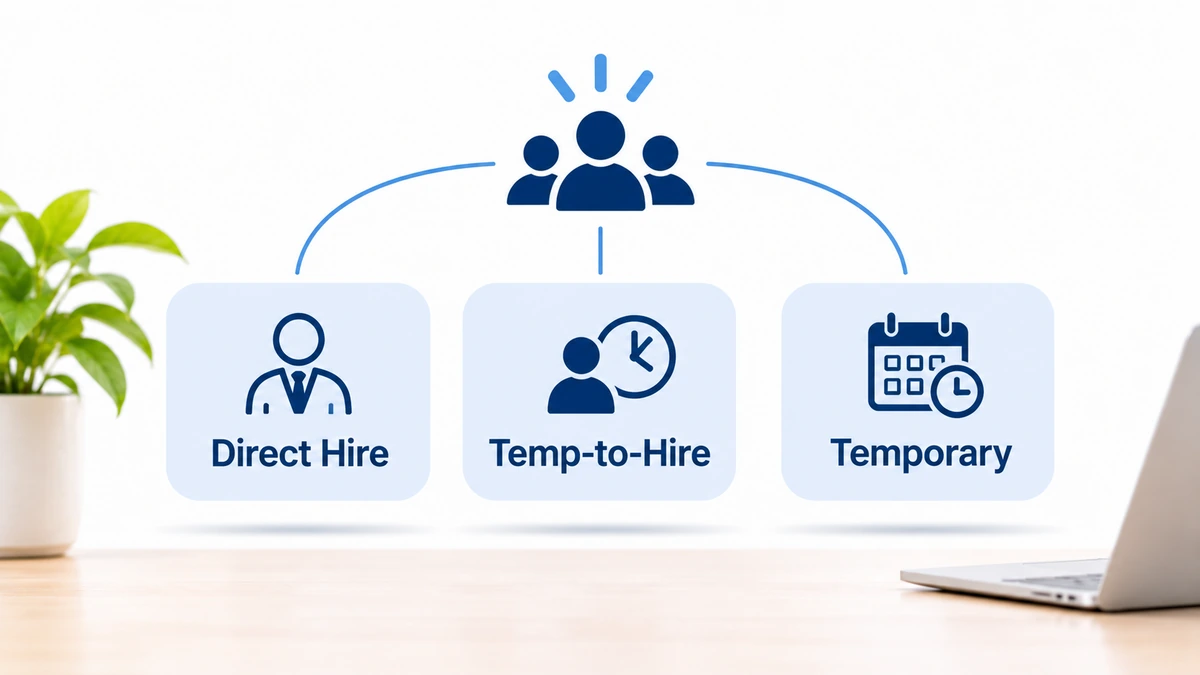
| Factor | Direct hire | Temp-to-hire | Temporary staffing |
|---|---|---|---|
| Who employs the worker | You, from day one | Agency first, then you | Agency |
| How you pay | One-time placement fee | Hourly bill rate, then a possible conversion fee | Hourly bill rate |
| Typical cost basis | 15% to 25% of first-year pay | Markup on hourly pay | Markup on hourly pay |
| Trial period | No, only a guarantee | Yes, on assignment | Yes, ongoing |
| Best for | Long-term, key roles | Testing fit before hiring | Short-term or seasonal needs |
Temp-to-hire works differently. You pay an hourly rate first. Then you may pay a fee to convert. Learn more in our guide to the temp-to-hire conversion fee. Not sure how staffing models work? Read how staffing agencies work.
Direct hire placement fees often make sense. The role is long-term. The role is key to your team. You want the worker on your payroll now. You trust a strong screening process.
Guarantee Periods: What Happens If a Hire Leaves?
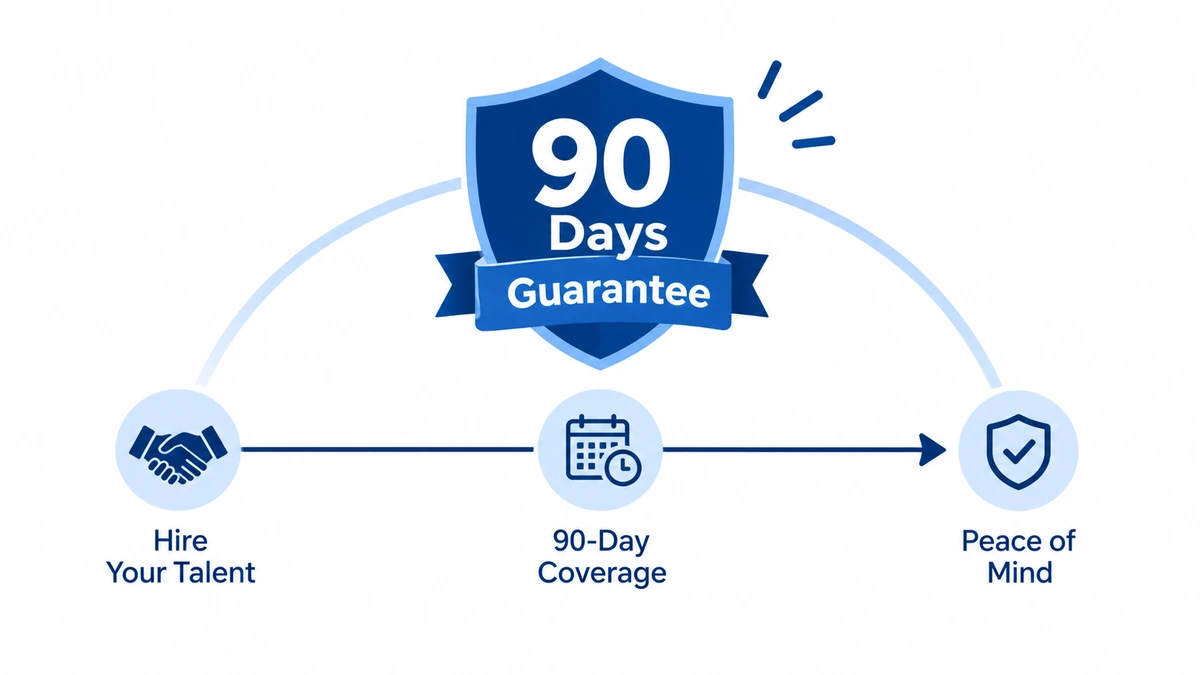
Many direct hire placement fees come with a guarantee. A guarantee protects you if the hire leaves early. It covers a set window after the start date.
Top Echelon surveyed recruiters in its network in 2019. Among them, 90 days was most common. About 44.9% reported a 90-day guarantee. About 20.3% offered 30 days. About 20% offered 60 days. Longer guarantees were rare. This was a network survey, not a census.
Guarantees come in three main types:
- Free replacement. The firm runs the search again. You pay no new fee.
- Full refund. You get the whole fee back. This often applies only early on.
- Prorated refund. You get part of the fee back. The amount shrinks over time.
Here is a prorated example. Your fee was $12,000. The guarantee is 90 days, prorated. The hire leaves on day 60. Two-thirds of the window has passed. You get one-third of the fee back. That is $4,000.
Read the fine print on direct hire placement fees closely. Guarantees often have exclusions. Layoffs may not be covered. Big job changes may void coverage. Late payment can also void it. Ask each firm to explain its terms.
When Are Direct Hire Placement Fees Due?
Most direct hire placement fees are due after the start date. Some firms bill on the offer date. Others bill on day one. Payment terms often run 10 to 30 days.
Watch for these timing terms:
- Invoice trigger. Is it the offer, acceptance, or start?
- Payment window. How many days do you have?
- Late fees. Is interest charged on late bills?
- Guarantee link. Does late payment void the guarantee?
Retained searches handle direct hire placement fees differently. You pay in stages. The first payment starts the search. The last one comes at hire.
Contract Terms That Affect the Real Cost
The headline rate is only one part of direct hire placement fees. Several other clauses shape what you pay. Look for each one below.
Candidate ownership period. Say you skip a candidate today. Then you hire them later. Many contracts still charge a fee. The window is often six to twelve months.
Rehire and referral rules. What if a candidate refers a friend? What if you hire them for another role? Some contracts charge for both. Ask how these cases work.
Fee floors. Some firms set a dollar floor. This matters for lower-paid roles. A 20% rate may not apply.
Off-limits rules. Good firms will not poach your staff. Ask if this is in writing.
Exclusive terms. An exclusive deal may lower your rate. But it may also lock you in. Check how long it lasts.
How to Negotiate Direct Hire Placement Fees
Direct hire placement fees are often open to talks. Most firms want a long-term partner. Use these tips to get fair terms.
- Offer exclusivity. Give one firm the role for 30 days. Ask for a lower rate in return.
- Bundle your roles. Hiring several people? Ask for a volume rate.
- Lock the fee base. Agree on base pay only, if you can.
- Ask for a longer guarantee. Trade a slightly higher rate for more protection.
- Cap the fee. Set a top dollar amount for high salaries.
- Agree on timing. Bill on start date, not offer date.
- Get it in writing. Every term belongs in the signed agreement.
Do not judge direct hire placement fees on rate alone. A cheap search can cost more later. A poor fit may leave in weeks. Then you start over. Focus on quality, speed, and strong terms.
How to Budget for Direct Hire Placement Fees
A clear budget for direct hire placement fees makes hiring smoother. Follow these four steps. They work for one hire or many.
Step 1: List your open roles. Write down each role and its pay range. Use the top of the range to be safe.
Step 2: Pick a planning rate. Use 20% for most roles. Use 25% or more for rare or senior roles.
Step 3: Do the math. Multiply pay by the rate. Add the totals for all roles.
Step 4: Compare options. Some roles may suit temp-to-hire better. Others may suit internal hiring. Use direct hire where it adds the most value.
Direct hire placement fees may also count as a business expense. The IRS allows ordinary and necessary business expenses. Deductibility can depend on your tax situation. Ask your tax professional how this applies to you.
Common Mistakes Employers Make
Many employers overpay on direct hire placement fees without knowing it. Most mistakes are easy to avoid. Watch for these five.
Signing without reading the fee base. Bonuses can raise the bill a lot. Always check how the contract defines pay.
Ignoring the guarantee terms. A 90-day guarantee sounds safe. But exclusions can void it fast. Read every condition.
Using too many firms at once. Many firms may send the same candidate. That can cause fee disputes. Keep your list short.
Skipping the intake call. A vague job brief leads to weak candidates. Spend time on the role up front. Good input brings better hires.
Choosing only on price. The lowest rate is not always best. Look at screening quality and speed. Check reviews and references, too.
Questions to Ask a Recruiter Before You Sign
A short list of questions keeps direct hire placement fees in check. It also shows how a firm works. Ask each one below.
- What is your rate for this role?
- Is the fee on base pay or total cash?
- When is the invoice due?
- What guarantee do you offer?
- What voids the guarantee?
- How do you screen candidates?
- How fast do you usually present candidates?
- How long does candidate ownership last?
- Do you follow equal opportunity hiring practices?
The last question matters. Employment agencies must follow federal job discrimination laws. The EEOC offers guidance for employers. A good partner should explain its fair hiring steps. One answer does not prove compliance. Ask how the firm screens fairly, too.
Is Paying a Direct Hire Fee Worth It?
Direct hire placement fees are a real cost. But so is a long, slow search. So is a bad hire. The right answer depends on your role.
A direct hire fee often makes sense when:
- The role is hard to fill.
- Your team lacks time to recruit.
- The role is key to your business.
- Past internal searches took too long.
- You need access to passive candidates.
Hiring on your own may make sense when:
- The role is easy to fill.
- You have a strong internal recruiter.
- You get many qualified applicants.
- You are not under time pressure.
Want to explore more? Read why employers use a staffing agency. You can also see how staffing agencies save money. Check our talent acquisition trends for 2027, too.
How Jomsom Staffing Supports Direct Hire
Jomsom Staffing is a workforce solutions provider. Jomsom states it offers several hiring models. These include temporary staffing and temp-to-hire. They also include direct hire and executive recruiting. Jomsom also offers payrolling and employer of record services.
Local owners own and run each Jomsom office. A national franchise system backs each one. Jomsom states this helps offices know local hiring markets. Jomsom supports office, light industrial, and skilled industrial roles. It also supports IT, engineering, and professional roles. It covers non-clinical healthcare roles, too.
Jomsom states its approach is relationship-driven. Recruiters start by learning your needs. They ask about skills, culture, and pay. Then they search and screen for fit. Each client agreement sets the direct hire placement fees and terms. Ask your local office for details.
Ready to hire a permanent team member? Request talent from Jomsom. You can also find a nearby office. Have questions first? Contact our team.
Related guides: How to choose the best staffing agency | Exempt vs. non-exempt employees
Frequently Asked Questions
What are typical direct hire placement fees?
A common planning range is 15% to 25%. The base is first-year pay. SIA’s 2021 survey found 20% was most common. Senior or rare roles may cost more.
Who pays the direct hire placement fee?
In the US, the employer usually pays. The job seeker does not pay the fee. The fee is part of the employer’s hiring cost.
When do I pay a direct hire fee?
Most fees are due after the hire starts. Payment terms often run 10 to 30 days. You pay retained searches in stages. Check your contract for exact dates.
Are direct hire placement fees refundable?
Many are, under a guarantee. Among surveyed recruiters, 90 days was most common. You may get a refund or a free replacement. Some firms prorate refunds over time.
Can I negotiate direct hire fees?
Often, yes. Offer exclusivity or more roles. Ask for a lower rate in return. You can also negotiate the fee base and guarantee.
How is direct hire different from temp-to-hire?
With direct hire, you hire from day one. You pay a one-time fee. With temp-to-hire, the agency employs the worker first. You pay hourly. A conversion fee may follow.
Is a flat fee better than a percentage?
It depends on the role. Flat fees are easy to budget. They can save money on high salaries. Percentage-based direct hire placement fees are more common.
Do direct hire placement fees include bonuses?
Sometimes they do. It depends on the contract. Some fees use base pay only. Others use total first-year cash. Always ask before you sign.
Disclaimer
Franchise Disclaimer: This is not an offer to sell a franchise. We make offers only through a Franchise Disclosure Document (FDD), in line with the law.
Statement: We are an Equal Opportunity Employer. All qualified applicants will get consideration. There will be no regard to race, color, religion, sex, or other protected status.
HIPAA Statement: We protect all personal health information. We follow HIPAA privacy and security standards.